
close
Choose Your Site
Global
Social Media
Views: 0 Author: Site Editor Publish Time: 2026-06-18 Origin: Site


An electric cargo bike is a utility bicycle built to carry heavy loads — cargo, equipment, or passengers — with the assistance of an electric drive system. For bicycle brands and fleet operators sourcing electric cargo bikes, the decisive engineering factor is not the motor: it is the frame. A cargo e-bike frame must absorb the combined stress of payload weight, rider input, and motor torque over thousands of duty cycles, which is why frame material, joint design, and welding quality determine whether an electric cargo bike performs reliably in real-world urban logistics.
This guide explains the defining features of an electric cargo bike, how its frame structure differs from a standard bicycle, and what OEM buyers should evaluate when selecting a manufacturing partner.
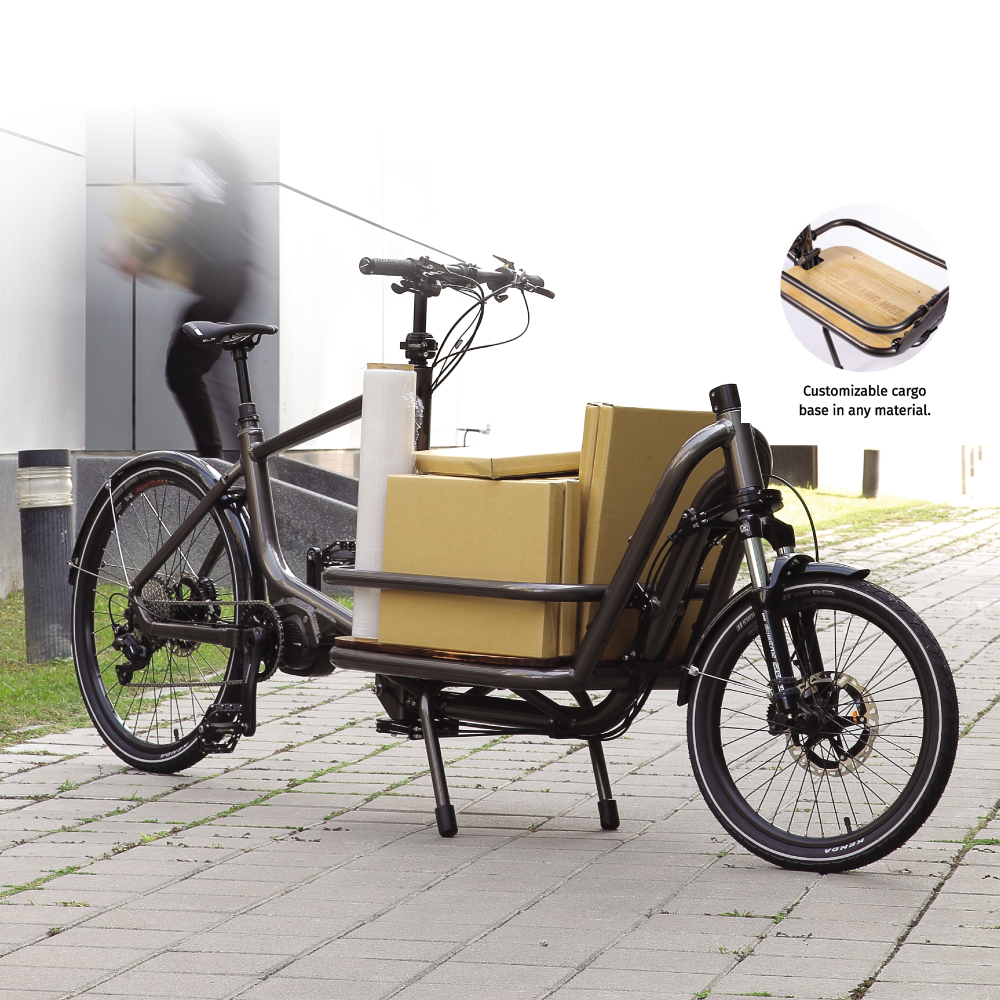
An electric cargo bike combines three engineered systems: a reinforced load-bearing frame, an electric assist drivetrain, and a cargo platform or carrying zone. Unlike a conventional bicycle, where the frame primarily supports the rider, a cargo e-bike frame is designed around the load path — the route that payload weight travels through the structure to the wheels.
Electric cargo bikes are typically categorized by configuration:
• Two-wheel (longtail / mid-tail): extended rear section over a single rear wheel, balancing maneuverability with carrying capacity.
• Three-wheel (trike): two wheels on one axle for a stable cargo platform, favored for heavier or bulkier loads.

• Front-load (long john): a low cargo box between the rider and the front wheel.
Across all configurations, the electric assist system allows riders to move significant payloads with reduced physical effort, making cargo e-bikes a practical replacement for short-haul delivery vehicles in dense urban environments.

A cargo e-bike frame carries structural demands that a standard frame does not. Three differences matter most for manufacturing:
In a standard bicycle, rider weight sits between the wheels. In a cargo bike, payload is concentrated at the cargo zone — rear rack, front box, or trike platform — creating bending and torsional loads at the frame's main junctions. Manufacturers reinforce these zones through larger-diameter or thicker-walled tubing, gusseting at high-stress joints, and weld placement that follows the load path rather than convenience.
Electric assist introduces additional torque at the drive area and adds the weight of the motor and battery to the structure. Frame design must accommodate motor mounting, battery housing, and internal cable routing while maintaining structural continuity. This is where welding process selection becomes critical — joints near the drive zone and battery mount endure cyclic loading and must be executed with consistent penetration and minimal distortion.
Because a cargo e-bike frame experiences higher and more variable loads than a standard frame, weld integrity directly governs fatigue life. A high-quality structural weld delivers consistent bead geometry, full penetration at the joint root, and minimal heat-affected-zone weakening. TIG welding is the primary precision process for aluminum alloy cargo frames, while robotic MIG welding supports consistent, repeatable joints across higher-volume production runs.
Material selection balances strength, weight, and manufacturability:
Aluminum alloy is the most common cargo e-bike frame material. The 6061 and 7005 series offer a strong strength-to-weight ratio, good weldability, and corrosion resistance — and 6061 responds well to T4/T6 heat treatment, which restores mechanical strength in the weld-affected zone after fabrication. Aluminum is the default choice for most production electric cargo bikes.
Chromoly steel (Cr-Mo) is selected by brands prioritizing fatigue resistance and ride compliance, particularly for heavy-duty or repair-friendly fleet applications. As cargo and utility cycling grows, dual-material capability — the ability to produce both aluminum and chromoly frames — is an increasingly valuable trait in an OEM partner. TIG welding serves as the primary structural process for both materials.
For load capacity, OEM buyers should specify their target payload to the manufacturer rather than relying on generic figures, since rated load support depends on frame geometry, material, tube specification, and intended use. Huang Wei engineers cargo frame structures to the buyer's defined load and use-case requirements.
Electric assist changes the structural job of a cargo bike frame. The motor - whether hub-mounted or mid-drive - introduces concentrated torque loads at its mounting interface, and mid-drive systems load the bottom bracket area far more heavily than pedal power alone. The battery adds a dense, rigid mass that must be mounted securely, typically on a reinforced downtube or integrated carrier, without creating stress concentrations. Frames must also route wiring internally or along protected paths, and mounting points must hold alignment through years of vibration. These requirements shape tube selection, gusset placement, and weld sequencing from the start of frame design. This is why OEM electric cargo bike frames are engineered as e-bike structures from the outset rather than adapted from standard cargo frames - and why manufacturers with in-house welding and T4/T6 heat treatment, such as Huang Wei, can control the strength of every reinforced joint.
Load support comes from deliberate engineering, not oversized tubes alone. Designers map the load paths - from cargo platform through the main triangle into the wheels - and reinforce the joints that concentrate stress: the head tube junction, bottom bracket shell, and cargo platform mounts. Tube wall thickness and cross-section are selected for the target payload, and gussets are added where fatigue loading is highest. Because rated capacity depends on geometry, material, and intended use, professional OEM manufacturers engineer each frame to the buyer's specified payload and application rather than quoting a universal figure. Production quality then determines whether the engineered strength is actually delivered: consistent full-penetration welds, post-weld T4/T6 heat treatment for 6061 aluminum structures, and documented inspection under an ISO 9001 quality system. Huang Wei applies TIG and robotic MIG welding with in-house heat treatment across its cargo e-bike frame production, including the 2-wheel and 3-wheel models exhibited at the 2026 Taipei Cycle show.
Sourcing electric cargo bike frames is a structural-engineering decision as much as a manufacturing one. Buyers should evaluate:
1. Multi-process welding capability — TIG for precision joints, robotic MIG for volume consistency, and brazing or laser welding for specific joint requirements.
2. Heat treatment in-house — T4/T6 capability for aluminum frames ensures post-weld strength recovery under controlled conditions.
3. Load-path engineering experience — a partner who understands cargo load distribution, not just standard frame production.
4. Reference production history — OEM supply to recognized brands signals proven quality systems.
5. Vertical integration — assisted design and development through welding, heat treatment, finishing, and delivery from a single partner reduces coordination risk.
A: An electric cargo bike is used to transport goods, equipment, or passengers using electric assist that reduces the physical effort of carrying heavy loads. Common applications include last-mile delivery, urban logistics, commercial fleet operations, and family transport. The electric drivetrain allows riders to move significant payloads over distance and gradient that would be impractical on a non-assisted cargo bike, which is why cargo e-bikes are increasingly adopted as a low-emission alternative to delivery vans in dense cities. The frame is the critical component, as it must reliably carry the combined load of cargo, rider, motor, and battery.
A: Aluminum alloy — typically 6061 or 7005 series — is the most widely used electric cargo bike frame material because of its strong strength-to-weight ratio, weldability, and corrosion resistance. Aluminum frames also benefit from T4/T6 heat treatment, which restores strength in the weld zone after fabrication. Chromoly steel is chosen by some brands for its fatigue resistance and compliant ride, particularly in heavy-duty or fleet applications. The best material depends on the target payload, intended use, and weight goals; experienced OEM manufacturers like Huang Wei produce both aluminum and chromoly frames and can advise on material selection based on a brand's specifications.
A: Rated load support for an electric cargo bike frame depends on the frame geometry, material specification, tube dimensions, and intended use, so there is no single universal figure. A frame engineered for commercial delivery carries a different rated load than one designed for family transport. The reliable approach for OEM buyers is to specify the target payload and use case to the manufacturer, who then engineers the frame structure — tube selection, joint reinforcement, and weld placement — to meet that requirement. Huang Wei engineers cargo frame structures to each buyer's defined load and application requirements rather than to a generic rating.
A: Welding quality is decisive because a cargo e-bike frame experiences higher and more variable loads than a standard bicycle frame, and weld integrity directly governs the frame's fatigue life. Poor welds — with incomplete penetration, porosity, or excessive heat-affected-zone weakening — become failure points under repeated cargo loading. High-quality structural welds deliver consistent bead geometry and full joint penetration. TIG welding is the primary precision process for aluminum cargo frames, and robotic MIG welding supports repeatable joints in volume production. Manufacturers with ISO 9001 certified quality systems, such as Huang Wei, document weld inspection as part of their production process.
A: Yes. Leading Taiwan OEM manufacturers offer custom electric cargo bike frame production, covering assisted design and development, material selection, welding, heat treatment, finishing, and delivery. Custom development typically begins with the buyer's specification — load target, configuration (two-wheel, three-wheel, or front-load), motor and battery integration requirements, and finish — followed by sample production and approval before volume manufacturing. Huang Wei provides one-stop OEM service for cargo e-bike frames and exhibited cargo e-bike models at the 2026 Taipei Cycle show. OEM samples are available for evaluation.
A: The core difference is the electric drive system - motor, battery, and controller - and the structural demands it creates. An electric cargo bike carries the same cargo loads as a non-assisted cargo bike plus the weight and torque of the drive system, so its frame needs reinforced mounting interfaces, stronger bottom bracket areas for mid-drive motors, and secure battery placement. Electric assist also enables heavier practical payloads and longer routes, which raises fatigue requirements. In short: a regular cargo bike frame is designed around cargo alone; an electric cargo bike frame is designed around cargo plus an integrated power system.
A: The battery and motor affect the frame in three ways. First, mounting: both need rigid, vibration-resistant interfaces - commonly a reinforced downtube for the battery and a dedicated interface for the motor. Second, loads: mid-drive motors concentrate torque at the bottom bracket, requiring stronger shells and joint reinforcement. Third, routing: wiring must run internally or along protected paths without weakening the tubes. These requirements are built into tube selection, gusseting, and weld placement during frame engineering, which is why battery and motor specifications belong in an OEM buyer's first briefing to the frame manufacturer.
A: Check four things: engineering capability for e-bike-specific loads (motor torque, battery mounting, payload targets); welding quality systems - TIG and robotic MIG processes under ISO 9001 certification; in-house T4/T6 heat treatment for 6061 aluminum frames; and physical evidence, meaning samples with material documentation before volume commitment. Production history for recognized brands is the strongest signal - Huang Wei supplies aluminum frames to Giant, Taiwan's largest bicycle brand, and exhibited its 2-wheel and 3-wheel cargo e-bike models at the 2026 Taipei Cycle show. OEM samples are available for qualification.
Huang Wei Technology is an ISO 9001 certified OEM frame manufacturer based in Taiwan, with over 30 years of precision welding expertise. We have supplied aluminum alloy frames to Giant — Taiwan's largest bicycle brand — and manufacture aluminum frames for the THSR high-speed rail and Puyuma Express seating structures. Our two-wheel and three-wheel cargo e-bike models were exhibited at the 2026 Taipei Cycle show.
Our one-stop OEM service covers assisted design and development, welding (TIG, Laser, Brazing, MIG), T4/T6 heat treatment, surface finishing, and delivery — with expanding chromoly steel capability in 2026 for brands seeking dual-material cargo frame options.
OEM samples are availableContact Huang Wei to discuss your electric cargo bike frame requirements or request a sample. [Contact for OEM Quote] [Request a Sample] [View Cargo E-Bike Range] |


